The Operating System built for AI search.
Starting with Chef.
Let Chef cook.
Chef researches your topic in depth, writes an article engineered to rank on Google and in AI answers like ChatGPT, then creates the matching visuals: a featured image and a social-ready infographic. Research to ready-to-publish, in one workflow.
Our award-winning team specializes in GEO and AI Optimization. Start with a free audit to see exactly where AI search can and can't find your business.
AI is answering your customers'
questions before they reach you.
A zero-click search is when search engines, LLMs like ChatGPT, and social platforms answer your customers directly, and stop sending clicks to your website.
of website traffic is being lost to Google AI Overviews
Google's AI Overviews now answer queries directly on the search page, cutting organic click-through rates by more than half. Your content is being used to train answers, but visitors never reach your site.
User asks a question
Someone searches for a product, service, or answer in your industry.
AI answers instantly
Google AI Overviews, ChatGPT, or Perplexity generates a complete answer, no click needed.
Your site gets skipped
The user got what they needed. They never visited your website, saw your brand, or became a lead.
If you can't beat zero-click,
become the content AI cites.
There's a way to turn this around. Here's how ZeroClick OS makes your brand the answer AI engines pull from.
See how it worksFrom research to ready-to-publish.
over 19 sources across 5 platforms
Research
We research your topic across search, social, and competitor sites to find the keywords and questions that matter. Chef reads the room first. It pulls from Reddit, TikTok, Google, YouTube, podcasts, LinkedIn, Amazon reviews, ChatGPT and Google Trends before writing a single word.
Article
Chef writes a data-backed article engineered to rank on Google and in AI answers like ChatGPT.
Visuals
Chef creates a matching featured image and a social-ready infographic.
Your whole month in one sitting, while a freelancer is still scoping the first one.
- Rank for the keywords and questions that matter, on Google and AI search engines like ChatGPT, Perplexity, and Google AI Overviews.
- Publish data-backed articles, optimized for SEO and GEO, at scale, for a fraction of what freelancers and agencies charge.
- Get social-ready images and infographics that match each article and keyword, ready to post.
- Google rewards genuinely helpful content, no matter how it's produced. Every Chef article is deeply researched, data-backed, and written in a human voice, built to be useful, so it ranks.
The result: credible content that converts customers.
Built for agencies and in-house teams.
Deliver more client content. Improve your margins.
- Produce publish-ready, GEO-optimized articles for every client without growing your writer bench
- Stop paying freelancers per article or eating the content-agency markup. Chef runs about $42 to $89 per article
- Scale content across multiple clients from one platform
- Win the AI-search results your clients are now asking about
Hit your content calendar without hiring.
- Publish 4 to 20 articles a month on a steady cadence, no new headcount, no retainer
- Save on every article: about $42 to $89 with Chef vs ~$125+ per freelance article, images included
- Every article researched, GEO-optimized, and paired with social-ready visuals
- Rank in Google and AI answers (ChatGPT, Perplexity, AI Overviews)
Everything starts with your score.
The ZeroClick Score is a free, 60-second audit that measures your business across 6 AI-readiness dimensions. It tells you exactly where AI can find you, where it can't, and what to fix first. Your score is your baseline. Every product in ZeroClick OS is designed to move this number up.
- Agent Commerce Readiness
- AI Citation Presence
- Traditional SEO Foundation
- Technical AI Readiness
- Content Authority
- Entity Strength
The same article. Without the markup.
A freelance writer charges around $125 for one article, and content agencies mark that up to $300 to $500+ for the same words. Chef gives you a researched, GEO-optimized, publish-ready article with matching visuals, for less.
Typical US freelance rate. Agencies mark it up to $300 to $500+
- Words only, you supply the images
- You write the brief, manage revisions, chase deadlines
- Quality and turnaround vary writer to writer
- No GEO / AI-search optimization
- The markup pays for their margin, not better content
- Days or weeks per article
- Single article $89: full research, GEO, human-voice, all exports
- +$15 for a matching featured image and infographic
- On a plan, as low as ~$42/article-equivalent (Chef Pro)
- No contracts · 60-sec AI audit · SEO + GEO + AEO · human-voice that ranks
Same article. Better results. Let Chef cook.
Pick the plan that matches your publishing pace.
Chef plans deliver publish-ready, GEO-optimized articles every month. Scale up as your content engine grows. No contracts.
Chef Starter
4 articles a month, enough to run a one-a-week content calendar, or generate all four in a day. Your schedule.
- Full 7-pass brief
- over 19 sources across 5 platforms
- Human-voice compliant (11 checks)
- GEO-optimized for AI citations
- Zero-plagiarism (5-word scan)
- Meta title, description & slug
- Exports: Markdown, HTML, DOCX, PDF
- All content types (blog, pillar, guide, how-to)
- Unlimited Pro Briefs
- Standard processing queue
- Media pack +$15/article
Chef Growth
8 articles a month, keep a two-a-week calendar full, or batch them whenever you want.
- Full 7-pass brief
- over 19 sources across 5 platforms
- Human-voice compliant (11 checks)
- GEO-optimized for AI citations
- Zero-plagiarism (5-word scan)
- Meta title, description & slug
- Exports: Markdown, HTML, DOCX, PDF
- All content types (blog, pillar, guide, how-to)
- Unlimited Pro Briefs
- Priority processing queue
- Media pack +$15/article
Chef Pro
20 articles a month, a five-a-week publishing engine, or generate on your own schedule.
- Full 7-pass brief
- over 19 sources across 5 platforms
- Human-voice compliant (11 checks)
- GEO-optimized for AI citations
- Zero-plagiarism (5-word scan)
- Meta title, description & slug
- Exports: Markdown, HTML, DOCX, PDF
- All content types (blog, pillar, guide, how-to)
- Unlimited Pro Briefs
- Media pack INCLUDED: featured image + infographic on every article (two images per article)
- Top-priority processing queue
- Quarterly 30-min strategy call
Chef Enterprise
40 to 150+ articles a month. Custom volume, team seats, a dedicated strategist, and SLA support.
- Full 7-pass brief
- over 19 sources across 5 platforms
- Human-voice compliant (11 checks)
- GEO-optimized for AI citations
- Zero-plagiarism (5-word scan)
- Meta title, description & slug
- Exports: Markdown, HTML, DOCX, PDF
- All content types (blog, pillar, guide, how-to)
- Unlimited Pro Briefs
- Custom volume (40 to 150+/mo)
- Media pack included
- Team seats
- Dedicated strategist
- SLA & priority support
- Custom workflows
Not ready to subscribe? Start with a free research brief, then have Chef write the article for $89 (add featured image + infographic for +$15).
Cooked up in minutes. Less than a business dinner.
Your monthly articles are yours to use any time: publish on a steady calendar or generate them all at once. The weekly pace is just a guide.
Declining rankings, reversed.
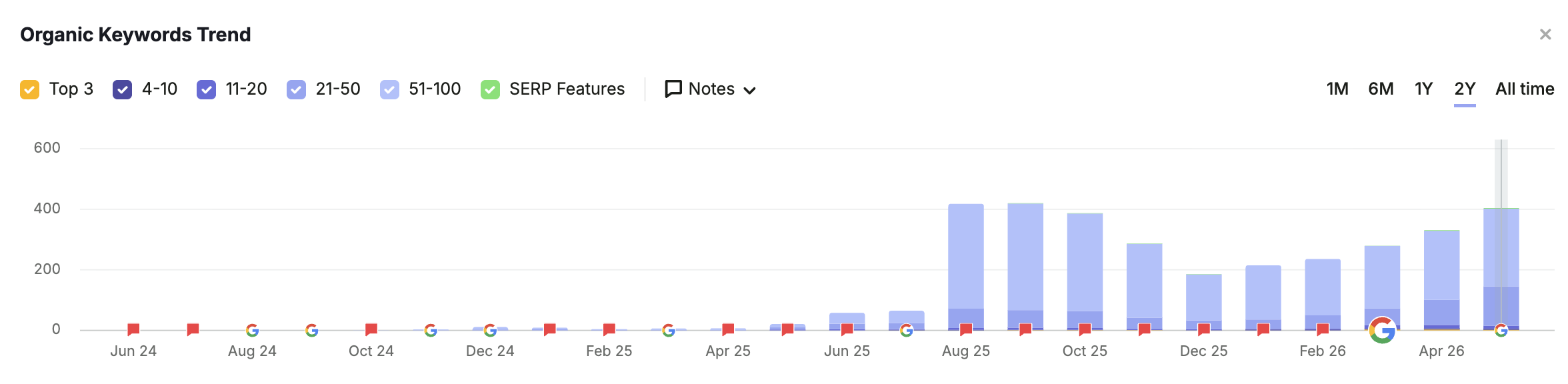
When Porter Yachts came to us, their organic visibility was sliding. We started in December. Here's what's happened since.
Organic keyword growth
Porter Yachts: total ranking keywords by position bucket, Jun 2024 to May 2026.
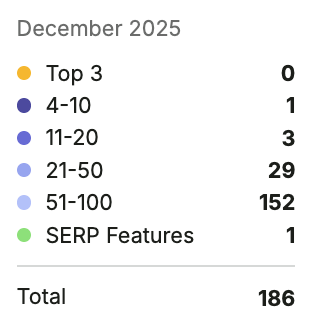
December 2025: 186 keywords
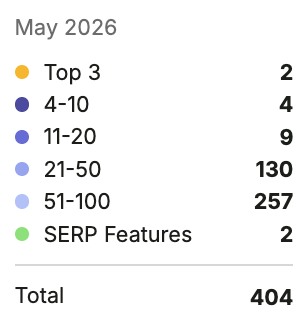
May 2026: 404 keywords
Source: Semrush organic keywords, December 2025 to May 2026. Rankings fluctuate; data as of May 2026.
Results worth talking about.
"I got an immediate 20% increase in keyword rankings from these articles. Then the leads rolled in. I love that the research solves problems prospects are searching for, and they rent yachts when they find us as a result."
"The ZeroClickOS process of using AI engineering tools to build beautiful content and websites is incredible. It's almost too good to be true. I love working with the team and highly recommend them."
"Chef's AI articles drive our SEO/GEO strategy. It increased gameplay on our website by 55%."
SEO got you on Google.
GEO gets you in ChatGPT.
Generative Engine Optimization (GEO) is the practice of structuring your content and technical signals so AI language models can read, understand, and cite your business. It's not about keyword stuffing, it's about making your business machine-readable.
Answer Engine Optimization (AEO) takes it further, structuring your content to directly answer the questions AI users ask. When someone asks ChatGPT "what's the best personal injury lawyer in Austin," AEO is why your firm shows up in the response.
ZeroClick OS builds both into every site. llms.txt tells AI who you are. Schema markup gives it structured facts. FAQ formatting feeds answer engines. The result: your business becomes a source AI trusts and recommends.
Optimize for Google's crawler. Compete for 10 blue links. Hope for a click.
Optimize for AI models. Structure data so machines understand your business. Get cited in AI-generated answers.
Structure content as direct answers to real questions. When AI gets asked about your industry, your business is the answer.
One system. Every AI search engine.
ZeroClick OS doesn't optimize for one platform. We build the technical foundation that makes your business visible across every AI search engine, now and as new ones emerge.
The future is bot-to-bot.
Is your business ready?
AI agents are already booking appointments, comparing vendors, and making purchase recommendations on behalf of users. Soon, the buyer's AI will talk directly to your website's AI. The businesses that prepare now will own this channel.
ZeroClick OS is the first web agency building for this future. Our Agent Commerce Readiness dimension in the ZeroClick Score measures how prepared your business is for bot-to-bot commerce. Check your score now
Frequently asked questions.
Everything you need to know about GEO, AEO, and optimizing for AI search.
Ready to get found by AI?
Your free ZeroClick Score takes 60 seconds. It shows exactly where AI search can and can't find you, and tells you what to do next.
Then optimize your existing pages, start the growth loop with content and interactive tools, or explore a full rebuild. Your score tells you where to start.
Get your free score, then let Chef cook. Yum!